General des Entrayes
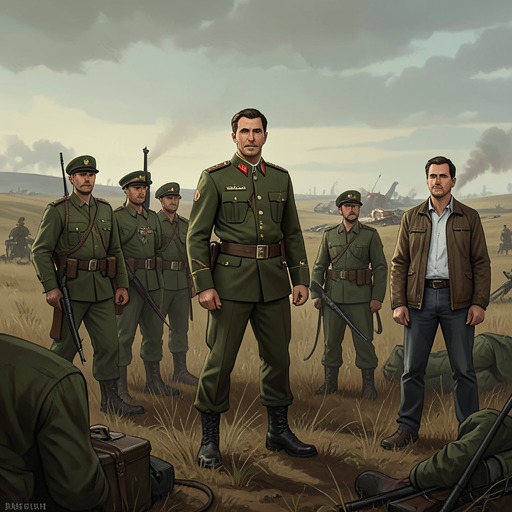
Journey to the End of the NightGeneral des Entrayes is a French general whose pursuit of comfort persists amid a month-long retreat. Ferdinand Bardamu first describes him as a quiet, unassuming man who seems neither cruel nor heroic, then shows the machinery of privilege around him: clean beds and modern kitchens must be found wherever the staff stops, even at the cost of leaving ordinary soldiers outside. In Bardamu’s account, the general’s apparent mildness masks a command that treats the needs of the powerful as urgent and the bodies of the rank and file as expendable.
Identity and Command
Bardamu becomes a corporal at the end of August and is repeatedly sent with five men to headquarters on liaison duty under General des Entrayes. The assignment places him close to the general’s daily arrangements, but not in a position to question them. He observes a small man who says little and does not initially announce himself as either a monster or a hero. The decisive measure of his character is instead what he expects others to provide: wherever the army halts, his orderly must find him a good clean bed and a kitchen equipped with modern conveniences.
The standard holds during a retreat that has already lasted more than a month. At each new stopping place, the general berates those responsible if his requirements have not been met. Comfort is not an occasional indulgence in Bardamu’s portrait; it is the general’s constant preoccupation, maintained while the army retreats and the men carrying out his orders move through exhausting conditions.
Privilege and Its Costs
The general’s domestic demands trouble his chief of staff, who is described as yellow, severely gastritic, and constipated, and who has little interest in food. Nevertheless, he must eat soft-boiled eggs at the general’s table and listen to the general’s complaints. Bardamu presents this obligation not as a private irritation alone but as one more service imposed by rank: even the officer who resents the arrangements has to participate in them.
The greater cost falls on soldiers displaced to preserve the general staff’s comfort. After a day of dragging themselves uphill and down through glades, carrots, and clover, the men find a quiet, sheltered village for the general to sleep in. If troops have already been billeted there—even if they have stacked their rifles—they are driven out in a hurry and left to spend the night in the open. The village is reserved for the staff, its horses, mess, and luggage, as well as Major Pinçon. The sequence makes the hierarchy tangible: retreat does not suspend privilege but gives it another village, another bed, and another group of soldiers to displace.
The general’s position is also visible at dinner. In a specially requisitioned house, his table is set and his lamp is in place while the liaison men are still being sent out on errands. The cook sometimes slips them a bite before they leave, because the general has more food than he can eat: regulations allow him forty rations for himself. Bardamu notes that he is nearing retirement age, walks with buckling knees, and appears to dye his moustache. These details place bodily frailty alongside the abundance and deference his command secures.
Orders, Retreat, and Exposure
Major Pinçon repeatedly summons the liaison men and sends them back out after they have spent the day running errands for the general. On one evening, as the general is about to sit down to dinner, Pinçon shakes a lantern under their noses and orders the whole lot of them to leave. Bardamu connects the major’s excitement at sending the men away to their deaths with a brief flush in his otherwise pale cheeks. The general is not the speaker in this scene, but the requisitioned meal supplies its center: his dinner proceeds while the soldiers are driven back into danger.
The retreat also shows the distance between the general’s protected routine and the confusion beyond it. Bardamu’s party fails to find Barbigny, circles through the night, and reaches another village by morning. The general is taking black coffee in an arbor outside the mayor’s house. Seeing the men pass, he remarks to Pinçon, “Youth is so wonderful!” He then goes out to urinate and takes a short walk, stooped with his hands behind his back. His orderly explains that the general slept badly because of bladder trouble. The episode sets a comfortable morning ritual against the night’s fruitless movement, while the general’s bodily inconvenience receives attention that the larger military disorder does not.
Bardamu’s Judgment and Narrative Role
Bardamu’s judgment grows harsher as the general’s privileges become legible. During a reconnaissance assignment, Bardamu is sent alone before daylight to determine whether enemy forces occupy Noirceursur-la-Lys. He understands his own choice of cowardice as a reason others take him for unusually calm, yet the mission sends him into danger with his equipment clanking around him. Reflecting on the general’s authority, he compares the contempt for human bodies in the story of Aztec sacrifices to the contempt his own “humble viscera” must inspire in General Celadon des Entrayes, whom promotions have made into a “chickenshit god” and an “abominably exigent little sun.”
The comparison turns the general’s appetite for comfort into an image of power without reciprocal responsibility. Bardamu is assigned the risk; the general’s needs organize the men’s movements and the places where they may sleep. The sun image also darkens the earlier portrait of a man who seemed, at first sight, neither cruel nor heroic: what appears as personal fussiness becomes a governing force, demanding service while remaining sheltered from the danger imposed on others. General des Entrayes is therefore less a portrait of battlefield courage than a figure through whom the narrative exposes military privilege, the expendability of soldiers, and the gulf between command and those sent out to die.